

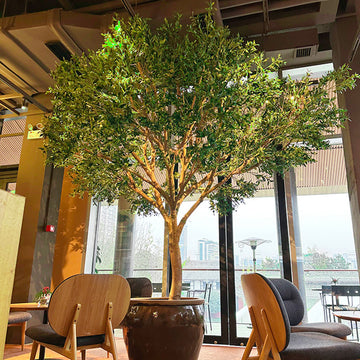


The modern dining experience is about far more than food. Atmosphere, spatial identity, and emotional resonance are now central to how guests choose where to eat — and how long they stay. Across the hospitality industry, artificial trees for restaurants have emerged as one of the most effective tools for creating immersive, nature-inspired environments that guests remember. From Mediterranean bistros draped in faux olive branches to tropical beach bars anchored by towering coconut palms, the most compelling restaurant interiors of today are defined by bold, intelligent use of greenery. This editorial guide explores how to choose, place, and design with artificial trees in restaurant settings — and explains exactly what separates a sophisticated installation from a costly mistake.
The Rise of Biophilic Design in Restaurant Interiors
Biophilic design — the practice of integrating natural elements into built environments — has moved from architectural theory to commercial mainstream over the past decade. Restaurants in particular have embraced this approach, recognizing that guests dining in green, nature-adjacent spaces linger longer, spend more, and return more often. The psychological mechanisms behind this are well-documented: natural elements reduce cortisol levels, lower ambient stress, and activate a sense of calm and well-being that directly shapes dining satisfaction. When a guest walks into a restaurant and instinctively feels at ease, greenery is often doing much of the work.

The translation of biophilic principles into hospitality design takes many forms — living walls, water features, natural materials — but trees occupy a uniquely powerful role. A well-placed tree anchors a room visually, introduces scale and verticality, and establishes a sense of permanence. Mediterranean restaurants have long understood this, using olive and fig trees to evoke the warm, convivial character of southern European dining. Tropical cafés and beach bars have similarly built entire brand identities around lush palm canopies and cascading leaf textures. Modern hotel restaurants increasingly rely on statement specimen trees — oversized fiddle leaf figs, dramatic banyans, architectural bonsai — to define their visual character and provide Instagram-worthy focal points that generate organic social media exposure.
For all its design appeal, however, biophilic design using live plants presents genuine operational challenges in restaurant environments. Commercial kitchens generate heat, humidity fluctuations, and grease particulate that are hostile to most plant species. Dining rooms with deep floor plans often lack the natural light that healthy plants require. The result is that genuinely thriving live greenery in restaurant interiors is far rarer than it appears — and far more expensive to maintain. High-quality faux greenery for restaurants solves this tension elegantly, delivering the full visual and atmospheric impact of biophilic design with none of its operational liabilities.
Why Restaurants Choose Artificial Trees Over Live Plants
The operational realities of running a restaurant are unforgiving. Every square foot of space, every hour of staff time, and every maintenance cost is scrutinized against its contribution to the guest experience and the bottom line. Live plants, however beautiful in theory, introduce a set of ongoing operational demands that few restaurant environments can sustainably absorb. A large live tree requires consistent watering schedules, regular pruning, seasonal fertilization, pest monitoring, and — when things go wrong, as they inevitably do — replacement. For a restaurant operating at pace, these requirements create friction that is difficult to justify.
Artificial indoor trees for restaurants eliminate these pressures entirely. A premium artificial olive tree or a large faux palm delivers consistent, beautiful visual impact every day of the year, regardless of the lighting conditions, the kitchen environment, or the attention of the floor staff. It will not drop leaves onto a guest's plate. It will not attract fruit flies in summer. It will not wilt during a busy dinner service when nobody remembered to water it. For high-volume operations, hotel restaurants, and multi-site hospitality groups, the case for commercial artificial trees is straightforward: they perform reliably, they look exceptional, and they require virtually no ongoing cost after installation.
- No watering or daily maintenance required
- Consistent appearance year-round, regardless of season or climate
- No risk of pests, plant diseases, or infestations
- Works in spaces with limited or no natural light
- Durable for high-traffic hospitality environments
- No leaf drop, sap, or organic debris near food service areas
- Immediate impact — no waiting for plants to establish or grow
- Long-term cost efficiency compared to repeated live plant replacement
It is worth noting that the stigma once attached to artificial plants in upscale settings has been substantially eroded by advances in manufacturing quality. Today's premium artificial restaurant plants use botanical-accurate leaf structures, hand-finished natural wood trunks, and UV-stable materials that are genuinely difficult to distinguish from their living counterparts — even at close range. The conversation in hospitality design has shifted from "real versus fake" to "quality versus poor quality," which is an entirely different and more productive debate.

Best Types of Artificial Trees for Restaurants
Different restaurant concepts call for different tree species and scales. The most successful installations are those where the choice of tree reinforces the restaurant's broader design language, cuisine identity, and target guest experience. Below is an authoritative overview of the most effective artificial tree categories for restaurant use, along with specific product recommendations from Faux Natural's commercial collection.
Artificial Olive Trees
Artificial olive trees are among the most versatile and widely used decorative trees in contemporary restaurant interiors. Their characteristically gnarled trunks, silvery-green foliage, and graceful branching structure evoke the warmth of Mediterranean landscapes with an ease and sophistication that few other species can match. In the right context — a wine bar in a converted warehouse, an Italian trattoria, a Provençal-inspired bistro, or a modern Mediterranean concept — a well-placed olive tree transforms the spatial character of a dining room entirely. They are equally effective as room dividers, entrance statements, and clustered grove features.

For maximum impact in larger dining spaces, the 12-foot artificial olive tree from Faux Natural delivers exceptional presence and architectural scale. Its densely foliaged canopy and lifelike trunk detail make it an ideal centerpiece for double-height dining rooms and hotel restaurants. The 10-foot olive tree with natural wood trunk offers a compelling balance of scale and detail, with a hand-finished trunk that reads convincingly as genuine weathered olive wood — an important consideration for upscale environments where guests may examine the trees closely. For intimate dining spaces, private rooms, or bar areas, the 8.5-foot olive tree provides strong visual impact without overwhelming the space, while the 10-foot indoor/outdoor variant is well-suited to covered terraces, courtyard dining, and transitional spaces where weather resistance is required.
1. 12-foot artificial olive tree

2. 10-foot olive tree with natural wood trunk


4. 10-foot indoor/outdoor variant
Artificial Palm Trees
Artificial palm trees are the defining species for tropical restaurant concepts, beach clubs, poolside dining, resort restaurants, and any hospitality environment built around a sun-soaked, escapist aesthetic. The architectural drama of a well-executed palm — its soaring trunk, radiating leaf crown, and inherent suggestion of warmth and leisure — is extraordinarily difficult to replicate through any other design element. For restaurant concepts where the guest's primary desire is transportation to another place and time, palms are the single most effective tool available.

The large artificial coconut palm with natural wood trunk is an outstanding choice for outdoor dining terraces, resort pool bars, and large-format tropical concepts. Its natural wood trunk construction and weather-resistant finish make it equally at home in interior installations and covered outdoor spaces. The 7-foot areca palm brings a lighter, more feathery texture suited to indoor dining rooms where a softer tropical note is desired without the full drama of a statement coconut palm. For spaces requiring a more compact footprint, the 7.5-foot natural-look palm and the lady palm / bamboo palm with pot offer refined botanical accuracy and are particularly well-suited to bar areas, reception spaces, and private dining rooms.
5. large artificial coconut palm with natural wood trunk


8. lady palm / bamboo palm with pot

Artificial Bonsai Trees
Artificial bonsai trees occupy a unique position in restaurant design — they are simultaneously decorative objects and philosophical statements. Their controlled, architecturally precise forms reference centuries of Japanese horticultural tradition, and their presence in a restaurant interior signals an attention to detail and aesthetic restraint that guests instinctively perceive. Bonsai work particularly well in Japanese restaurants, sushi bars, modern Asian fusion concepts, and any contemporary dining space seeking a sculptural accent rather than a volumetric green statement.

The 6-foot artificial pine bonsai and its counterpart, the lifelike 6-foot pine bonsai for indoor décor, are impressive statement pieces suited to entrance foyers, host stands, and chef's table settings. The luxury artificial pine tree offers an elevated specification appropriate for Michelin-level dining rooms and boutique hotel restaurants where every object in the space is subject to the highest scrutiny. Smaller formats, such as the 2-foot bonsai pine, are effective as counter accents, shelf features, or paired decorative elements in minimalist settings.
9. 6-foot artificial pine bonsai

10, lifelike 6-foot pine bonsai for indoor décor

11. luxury artificial pine tree


Artificial Fiddle Leaf Fig Trees
Artificial fiddle leaf fig trees have become synonymous with contemporary interior design, and their popularity in restaurant settings reflects their extraordinary versatility. The large, glossy, architectural leaves of the fiddle leaf fig create a bold visual statement that complements modern, Scandinavian, and industrial-chic interiors with particular elegance. They are the tree of choice for specialty coffee shops, brunch restaurants, contemporary wine bars, and boutique hotel dining rooms that want to communicate design-forward sensibility without committing to a more thematically specific species.

The 13-foot fiddle leaf fig is a genuinely dramatic installation piece, capable of filling a double-height space with organic presence and anchoring an entire room around its form. The 10-foot version is the most commercially popular size for restaurant use — large enough to make a strong design statement, manageable enough to work in standard floor-to-ceiling heights. The fig tree with natural wood trunk offers premium finish quality that is particularly appropriate for fine dining environments.


15. fig tree with natural wood trunk

Artificial Cherry Blossom Trees
Artificial cherry blossom trees are among the most visually arresting options available in restaurant décor, carrying an immediate emotional charge that few other species can match. Their cascading pink or white blossoms suggest transience, beauty, and celebration — qualities that align naturally with the aspirational character of fine dining, special occasion restaurants, and upscale event venues. A cherry blossom installation executed with intelligence — combining tree-form structures with appropriate lighting and considered placement — creates spaces that guests feel compelled to photograph and share.

The 10-foot vibrant pink cherry blossom and the 10-foot sakura tree with pink blossoms are ideally suited to private dining rooms, event spaces, and destination restaurants seeking a seasonal signature without the logistical complexity of live flowering trees. The white cherry blossom bonsai offers a more restrained and elegant interpretation appropriate for minimalist Japanese concepts. For large-format installations and dramatic venue transformations, the 7–22 foot cherry blossom tree range provides the flexibility to configure statement canopy effects at any scale.
16. 10-foot vibrant pink cherry blossom

17. 10-foot sakura tree with pink blossoms

18. white cherry blossom bonsai

19. 7–22 foot cherry blossom tree range

Artificial Banyan and Ficus Trees
Artificial banyan and ficus trees are the definitive choice for large-scale statement installations in restaurants, hotels, and hospitality venues where the tree itself functions as architecture. The banyan's characteristic aerial root system and expansive canopy structure create a sense of age, gravitas, and wonder that is entirely unique in the world of decorative plants. Installed correctly in a restaurant atrium, a double-height dining room, or a grand entrance hall, a banyan tree becomes the defining feature of the entire space — the element around which everything else is organized.

The large artificial ficus tree with fiberglass trunk represents the highest specification available for commercial installations. Its fiberglass trunk construction delivers exceptional structural integrity alongside extraordinary visual realism — an important combination in environments where guests may walk beneath or around the installation. The fiberglass trunk ficus in a complementary configuration offers similar quality and is appropriate for slightly more compact grand-scale settings. These trees are ideally suited to upscale hotel restaurants, resort lobbies with dining, and large destination restaurants where the design budget and spatial ambition justify a centerpiece investment.
20. large artificial ficus tree with fiberglass trunk

21. fiberglass trunk ficus in a complementary configuration

Specialty and Statement Artificial Trees
Beyond the core species categories, a range of specialty artificial trees offers compelling options for restaurants seeking distinctive visual differentiation. The 8-foot golden red maple tree brings warmth and autumnal drama to Japanese, fusion Asian, and contemporary American restaurant interiors. The 8.5-foot artificial dracaena with its striking architectural silhouette is an excellent choice for modern and industrial restaurant interiors. The artificial bamboo tree and artificial banana tree round out the tropical palette beautifully, while the dramatically sculptural 13-foot artificial dead tree with fiberglass trunk has found an enthusiastic audience among avant-garde restaurant designers seeking installation-art-level décor statements. For restaurants in specific fire-code-sensitive environments, the fire-proof artificial mangrove tree provides peace of mind alongside strong visual character.
22. 8-foot golden red maple tree

23. 8.5-foot artificial dracaena


26. 13-foot artificial dead tree with fiberglass trunk

27. fire-proof artificial mangrove tree

What Doesn't Work: Common Design Mistakes with Restaurant Trees
For every successful artificial tree installation in a restaurant, there are examples that undermine rather than enhance the guest experience. Understanding the failure modes is as important as knowing what to aspire to — and it often separates the results of a thoughtful hospitality designer from an uninformed procurement decision. The single most damaging mistake restaurants make is choosing artificial trees based on price rather than quality. Low-quality plastic trees with unnaturally glossy leaves, implausible proportions, and visibly synthetic trunks do not merely fail to enhance a dining room — they actively damage the credibility of the entire interior. Guests are perceptive, and a clearly fake tree signals a broader inattention to quality that extends to their assessment of the food and service.
Scale mismatches represent the second most common failure. A tree that is too small for the space reads as an afterthought rather than a design intention; a tree that is too large for the ceiling height appears cramped and suffocating rather than impressive. The relationship between tree scale and ceiling height is particularly critical — as a general rule, the tree's canopy should occupy no more than a third of the vertical space available to it, with clear breathing room above the highest branches. Placement errors are equally consequential: trees positioned in server corridors or near high-traffic circulation routes create genuine operational hazards, and trees placed without consideration for lighting will look dramatically different — and often worse — than intended once the restaurant is operating under its designed ambient conditions.
- Using trees that look artificial or overly glossy — quality is non-negotiable in upscale dining environments
- Choosing tree sizes that are disproportionate to ceiling height or floor area
- Blocking guest pathways or server routes with poorly positioned planters
- Using too many trees without achieving design balance or intentional rhythm
- Ignoring lighting and shadow effects — trees without considered lighting lose most of their impact
- Mismatching tree species to restaurant theme — coconut palms in a French bistro, for example
- Selecting planters that conflict with the restaurant's material palette
Thematic misalignment is a subtler but equally important consideration. Every tree species carries cultural and aesthetic associations that will either reinforce or contradict a restaurant's concept. A coconut palm in a French brasserie creates cognitive dissonance; an olive tree in a Japanese izakaya misses the visual cue. The most successful restaurant tree installations are those where species selection, scale, placement, and planter choice all cohere into a design decision that feels inevitable — as if the tree could not possibly be anywhere else.

Design Tips for Using Artificial Trees in Restaurant Spaces
The difference between a tree that transforms a restaurant interior and one that merely occupies space in it comes down to intentional design thinking. Artificial trees should be considered as architectural elements — not accessories — and their placement should be planned with the same rigor applied to furniture layouts, lighting schemes, and material selections. The following principles represent best practice for hospitality designers and restaurant operators working with large artificial trees for restaurants.
- Use tall artificial trees to naturally divide dining areas into distinct zones without the visual heaviness of walls or partitions
- Place statement trees near entrances or host stands to establish immediate visual identity and first impressions
- Combine trees with warm, directional lighting — uplighting creates dramatic shadow plays on ceilings, while downlighting from above emphasizes canopy texture
- Use large planters that match the restaurant's interior material palette — terracotta for Mediterranean concepts, raw concrete for industrial spaces, rattan for tropical settings
- Keep all circulation pathways clear for staff and guests — plan for a minimum 900mm clear corridor around any planter
- Consider tree clusters rather than isolated specimens in larger spaces — groupings feel more naturalistic and spatially confident
- Use species consistently within a single concept — mixing unrelated tree types without a clear design rationale creates visual noise
For restaurant groups and hospitality developers managing multiple sites, the operational and aesthetic consistency offered by artificial trees becomes an additional asset. A standardized tree specification across a restaurant group's locations creates visual brand coherence while eliminating the variability inherent in live plant programmes. Wholesale artificial plants supply arrangements through Faux Natural make this kind of multi-site consistency practical and commercially efficient.
Recommended Artificial Trees from Faux Natural
Faux Natural's commercial collection is curated specifically for hospitality, retail, and architectural applications where quality, realism, and durability are non-negotiable. The following represent the standout options for restaurant use across scale and style categories. Browse the complete range of realistic artificial trees for the full selection.
12-Foot Lifelike Artificial Olive Tree
This is the definitive statement olive tree for restaurant interiors, combining exceptional scale with botanical accuracy that holds up to close inspection. Its densely layered canopy and hand-detailed trunk make it the most convincing large-format olive available for commercial use. Best suited to Mediterranean restaurants, wine bars, hotel dining rooms, and any double-height space where maximum visual impact is the design objective.
Large Artificial Coconut Palm Tree with Natural Wood Trunk
Constructed with a genuine natural wood trunk and weather-resistant materials, this coconut palm is built to the standard required by resort restaurants, beach clubs, and covered outdoor dining environments. Its architectural scale and convincing trunk detail make it an ideal centerpiece for tropical hospitality concepts where authenticity is paramount. Equally effective installed individually as a statement piece or grouped in threes to create an immersive tropical canopy.
13-Foot Artificial Fiddle Leaf Fig Tree
At 13 feet, this fiddle leaf fig is one of the most dramatic indoor installation pieces in Faux Natural's collection, designed for spaces where a tree needs to function as architecture rather than decoration. Its large, glossy leaves are botanically proportioned and rendered in natural-feel material that avoids the plastic sheen that compromises lesser alternatives. The ideal choice for contemporary hotel restaurants, flagship café concepts, and design-forward dining rooms with generous ceiling heights.
Large Artificial Ficus Tree with Fiberglass Trunk
The fiberglass trunk construction of this ficus tree places it in a different category from standard commercial artificial trees — it is built to the specification of a bespoke architectural installation rather than a décor product. The trunk's sculptural realism and structural integrity make it suitable for grand-scale hospitality venues, hotel atriums, and flagship restaurants where the tree will be a defining feature of the space for years or decades. An investment piece for projects where design permanence is the intention.
10-Foot Vibrant Pink Cherry Blossom Tree
Cherry blossom trees occupy a unique emotional register in restaurant design — they are inherently celebratory, visually arresting, and deeply evocative of special occasion dining. This 10-foot version delivers the full dramatic impact of a cherry blossom canopy in a commercially manageable format. Best suited to private dining rooms, event restaurant spaces, Japanese and pan-Asian concepts, and any venue seeking a seasonal signature that photographs beautifully.

6-Foot Artificial Pine Bonsai Tree
This large-format bonsai bridges the gap between decorative accent and statement specimen, offering the refined sculptural quality of traditional bonsai at a scale that reads confidently in commercial environments. Its precisely shaped canopy and detailed trunk structure work with particular effect in Japanese restaurants, modern Asian concepts, and minimalist dining rooms where a single, carefully chosen object defines the spatial character. Place at the host stand, beside a chef's counter, or as the focal point of a private dining room.
Frequently Asked Questions
Are artificial trees suitable for restaurants?
High-quality artificial trees are not only suitable for restaurants — they are often the superior choice for commercial hospitality environments. Unlike live plants, which require consistent watering, specialist lighting, and regular maintenance, premium faux trees for restaurants deliver consistent, beautiful results regardless of the kitchen environment, lighting conditions, or staff availability. They are food-safe, pest-free, and designed to withstand the demands of high-traffic commercial environments. Many of the world's most acclaimed restaurant interiors feature artificial greenery precisely because it performs at the standard that hospitality design requires.
Do artificial plants improve restaurant atmosphere?
Absolutely — and the evidence is both experiential and research-backed. Biophilic design research consistently demonstrates that nature-inspired environments reduce stress, increase guest satisfaction, and encourage longer dwell times. Artificial plants, when chosen at premium quality, deliver these same atmospheric and psychological benefits as their live counterparts. Guests respond to the visual presence of greenery and the spatial character it creates rather than to its biological status. A beautifully executed artificial olive tree grove in a Mediterranean restaurant creates the same warm, convivial atmosphere as a live installation — at a fraction of the long-term cost and operational complexity.
What size artificial tree works best in restaurants?
The ideal tree size depends on the specific spatial context: ceiling height, floor area, the tree's intended role (divider, statement piece, accent), and the overall design scale of the interior. As a practical guideline, trees in standard-height commercial dining rooms of 3–3.5 metres work best in the 7–10 foot range. Double-height spaces and hotel dining rooms can accommodate 12–15 foot specimens and above. The critical principle is proportion: the tree's canopy should feel at ease within the space rather than compressed against the ceiling or lost in an oversized floor area. When in doubt, scale up rather than down — a tree that is slightly larger than expected creates drama, while one that is too small disappears.
Are artificial trees safe for indoor dining spaces?
Premium artificial trees from reputable commercial suppliers are fully safe for indoor restaurant use. Faux Natural's commercial range is manufactured from food-safe, non-toxic materials that do not off-gas harmful compounds in enclosed dining environments. Fire safety is an additional consideration in commercial hospitality settings: for venues requiring compliance with specific fire codes, Faux Natural offers fire-rated options including the fire-proof artificial mangrove tree specifically designed for indoor commercial décor. Always confirm fire rating requirements with your local authority and specify accordingly when placing commercial orders.
How do restaurants clean artificial plants?
Artificial trees in restaurant environments require only periodic light maintenance to maintain their appearance. Foliage can be gently wiped down with a soft, slightly damp cloth to remove surface dust and any grease particulate from kitchen environments. For larger installations, a low-pressure compressed air duster can be used to clear dust from between leaf structures. Most premium artificial trees do not require special cleaning products — mild soapy water is sufficient for deeper cleans. This low-maintenance characteristic is one of the most operationally significant advantages of artificial restaurant plants over live alternatives, which require specialist care and can deteriorate rapidly if neglected.
Do artificial trees last long in commercial environments?
Premium commercial artificial trees are designed and built for longevity. High-quality products from suppliers serving the hospitality sector are typically rated for 5–10 years of commercial use under normal conditions, with many installations remaining visually excellent well beyond that timeframe. The key variables that affect lifespan are UV exposure — relevant for outdoor and sun-exposed installations, where UV-stable materials are essential — and the physical robustness of the trunk and branching structure. Fiberglass trunk constructions, such as those used in Faux Natural's premium ficus range, provide particularly exceptional durability in high-traffic commercial environments.
Can artificial trees be used outdoors at restaurants?
Many artificial trees in Faux Natural's commercial range are specifically designed for indoor/outdoor use, including covered terraces, rooftop dining areas, and courtyard restaurants. Products designated for outdoor use feature UV-stabilized foliage materials that resist fading from sun exposure and construction specifications suited to wind and humidity variation. The large artificial coconut palm with natural wood trunk and the 10-foot olive tree in indoor/outdoor specification are among the strongest choices for covered outdoor dining environments. Always confirm the specific product's outdoor rating before specifying for exterior or semi-exterior installations.
Conclusion: Why Artificial Trees Are a Smart Investment for Restaurant Interiors
The conversation around artificial trees for restaurants has matured considerably. What was once a compromise — fake plants for spaces where real ones couldn't survive — is now a sophisticated design choice that combines the aesthetic and psychological power of biophilic design with the operational reliability that modern hospitality demands. The best artificial trees available today are genuinely impressive objects: botanically accurate, structurally robust, visually indistinguishable from their living counterparts in the ambient conditions of a dining room, and built to perform for years without the ongoing costs that live plant programmes impose.
For restaurant owners, hospitality designers, and hotel development groups, the investment case is compelling. A premium artificial olive tree, a statement fiddle leaf fig, or a dramatic banyan installation is a long-term design asset that shapes guest perception from the moment they enter the space. It contributes to the brand story, provides spatial definition, and creates the kind of atmosphere that converts first-time visitors into regulars and regulars into advocates. In an industry where atmosphere is as commercially important as menu quality, trees are not a decorative luxury — they are a strategic investment in the guest experience.
Faux Natural's commercial collection offers the breadth, quality specification, and scale range to serve hospitality projects of any ambition — from a single statement olive tree in a neighbourhood wine bar to a multi-site installation programme for a hotel group. Explore the full range of artificial trees, browse the artificial olive tree collection, discover artificial palm trees for tropical concepts, or enquire about wholesale and commercial supply for your project.


