
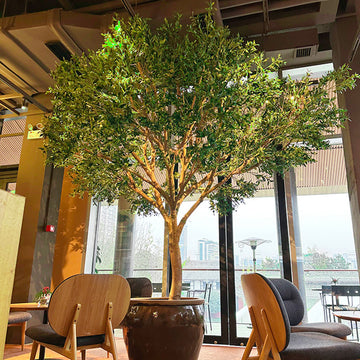


Few plants have captured the imagination of interior designers quite like the olive tree. With its silver-green foliage, gnarled sculptural trunk, and quietly ancient presence, it carries an unmistakable sense of calm and considered elegance into any interior. Over the past decade, the best olive trees indoors have become a signature feature in everything from whitewashed Mediterranean retreats to sleek organic modern apartments — and for good reason. They offer something most houseplants cannot: genuine architectural presence, effortless timelessness, and the kind of natural texture that makes a room feel both finished and alive. Choosing the right indoor olive tree, however, takes more thought than simply buying the first potted specimen you find. Scale, leaf realism, trunk character, canopy density, planter styling, and placement all play a role in whether your olive tree becomes a true design statement or simply an afterthought. And increasingly, many homeowners and interior designers are turning to high-quality artificial olive trees as the most practical, beautiful, and consistent way to bring this timeless plant indoors without the demanding maintenance of a live tree.

Why Olive Trees Work So Well Indoors
There is a reason olive trees have appeared in some of the most photographed interiors of the last several years. Unlike most indoor trees, the olive carries a certain quietness — a stillness that doesn't compete with furniture or architecture but instead settles naturally into whatever space it occupies. The soft, muted grey-green of its leaves is one of the most versatile tones in the natural world, sitting comfortably alongside warm neutrals, deep earthy shades, bright whites, and raw stone finishes. The branching structure of a mature olive tree also gives it a sculptural quality that few other plants can match: each branch bends and reaches with an organic irregularity that feels genuinely gathered from the landscape rather than manufactured for a pot.
In living rooms, an indoor olive tree placed beside a sofa or in a corner near a window transforms what might otherwise be an empty, under-furnished space into something layered and complete. In entryways, a tall olive tree creates an immediate sense of arrival — a quiet declaration of taste that sets the tone for the rest of the home. In bedrooms, a smaller olive tree adds texture and natural calm without demanding attention the way a more tropical or dramatic plant might. In home offices, the silver-green foliage provides a grounding visual backdrop that makes long working hours feel more human. And in dining spaces, a well-placed olive tree contributes an informal, European sensibility that encourages lingering at the table.
What makes the olive tree particularly versatile as an indoor plant, whether real or artificial, is that it never feels especially trendy. It belongs to a visual language that has been refined over centuries — the light of Tuscany, the terraces of Provence, the whitewashed villages of Andalusia — and that language translates with surprising ease into modern apartments, contemporary open-plan homes, and quiet minimalist interiors alike. An olive tree does not demand a particular style; it elevates whatever style already exists.

What Makes the Best Olive Trees Indoors?
Not every olive tree translates well from the garden or the nursery into an interior setting. When choosing the best indoor olive tree, the most important considerations are proportion, realism, and presentation. Scale is the first thing to get right. A tree that is too small for the room will read as tentative and decorative in a diminishing way — more of an ornament than a design element. Conversely, an oversized tree crammed into a low-ceilinged room will feel oppressive rather than elegant. As a general guide, rooms with standard ceiling heights work best with olive trees in the 6 to 8.5 foot range, while larger open-plan spaces or rooms with high ceilings can take something taller and more dramatic — 10 to 12 feet or beyond.
Canopy shape matters too. A full, rounded canopy creates a sense of lushness and softness that suits more relaxed, layered interiors — Mediterranean-style homes, organic modern spaces, rooms with plenty of texture and natural materials. A lighter, more open canopy with visible branching structure feels more architectural and suited to minimalist or contemporary settings where the silhouette of the tree is part of the visual interest. Trunk character is equally important. A thick, gnarled, naturally textured trunk gives the tree an aged authenticity that makes it feel genuinely credible as a specimen; a thin or uniform trunk, by contrast, can make even the most beautiful canopy feel insubstantial.
Leaf color and texture deserve particular attention. The most convincing indoor olive trees — whether real or realistic artificial trees — feature leaves with the right degree of variation: slightly silvery on the underside, deeper and more muted green on top, with a soft, non-glossy finish that reads as natural under interior lighting. Glossy or oversaturated leaves immediately signal artificiality and undermine the quiet sophistication that makes olive trees so appealing. And finally, the planter. The pot or planter in which an olive tree sits is not an afterthought — it is part of the composition. A beautiful tree in a cheap plastic nursery pot looks unfinished; the same tree in a raw terracotta vessel, a ribbed stone planter, or a textured cement pot becomes a considered design object.

Real vs Artificial Olive Trees Indoors: Which Is Right for You?
The debate between real and artificial plants has shifted considerably in recent years, and for good reason. The quality of the very best artificial olive trees has improved to a point where, in a well-lit interior, it is genuinely difficult to distinguish them from live specimens. More significantly, the practical arguments in favour of high-quality artificial olive trees have become increasingly hard to ignore for anyone furnishing a real home rather than a botanical garden.
Live olive trees can be beautiful indoors, but they come with a set of demands that most interiors cannot easily accommodate. They require significant direct sunlight — ideally six or more hours of it per day — which is simply unavailable in most apartments, north-facing rooms, or interior spaces without large south or west-facing windows. They are sensitive to fluctuations in temperature and humidity, which makes them particularly challenging in centrally heated homes during winter. They need consistent but not excessive watering, and getting that balance wrong tends to result in leaf drop, yellowing, or root problems that take months to correct. And even a well-cared-for live olive tree will shed leaves, drop olives if it fruits, and go through periods of sparse or dishevelled growth that do not photograph especially well in a design context.
For many homeowners, interior designers, and stylists working with real spaces and real budgets, a premium indoor faux olive tree solves all of these problems at once. The benefits speak for themselves:
- No watering or pruning required
- Consistent shape and color year-round
- No leaf drop or seasonal decline
- Works in rooms with limited natural light
- Easy to style in living rooms, bedrooms, and entryways
- Ideal for homeowners who want a polished, maintenance-free look
The key, of course, is choosing an artificial olive tree of sufficient quality. The wrong faux tree — with stiff, shiny leaves, an obviously synthetic trunk, and a uniform canopy that looks more like a mop than a specimen — is worse than no tree at all. The right faux tree, crafted with botanical accuracy, nuanced foliage coloring, and a realistically textured trunk, can be genuinely indistinguishable from a live plant and will hold its elegant appearance indefinitely without any effort on your part.
Best Types of Olive Trees for Different Indoor Spaces
Understanding how different tree types and sizes serve different interior purposes is the key to making a confident choice. There is no single "best" indoor olive tree — the right tree depends entirely on where it will live, how it will be seen, and what visual job it needs to do.
Small tabletop or shelf olive trees in the bonsai style suit apartments, bedrooms, and home offices where floor space is limited but a touch of organic texture is still desired. These compact specimens work beautifully on side tables, console tops, open shelving, and windowsills, where their miniaturised form is appreciated up close. They add the same silvery foliage and natural character as a full-sized tree but in a scale that is appropriate for intimate spaces.
Medium olive trees — broadly in the four to six foot range — are the workhorses of indoor olive tree styling. They suit bedroom corners, home offices, dining alcoves, and smaller living rooms where a full-scale statement tree would feel overwhelming. At this height, the branching structure is visible and elegant without demanding too much ceiling clearance, and the tree has enough presence to anchor a corner or complement a sofa arrangement without taking over the room.
Tall olive trees — from around eight to twelve feet — are the most architecturally commanding option and work best in spaces that can genuinely accommodate their presence: open-plan living rooms, double-height entryways, large dining rooms, hotel lobbies, and commercial spaces where scale is part of the design intention. At this height, an olive tree stops being a plant and becomes a genuine interior architectural element, lending the kind of drama and organic grandeur that is otherwise very difficult to achieve.
Full, lush-canopy olive trees with dense, rounded foliage suit interiors that lean toward warmth and texture — layered Mediterranean rooms, relaxed organic modern spaces, or any interior that benefits from softness over structure. More open, branchy trees with a visible, graphic silhouette suit minimalist, Japanese-inspired, or contemporary interiors where the negative space between branches is part of the visual composition.
Recommended Faux Natural Olive Trees for Indoors
Faux Natural's collection of artificial olive trees represents some of the most convincing, beautifully crafted indoor olive trees available. Each tree is designed with a genuine understanding of how olive trees look and behave in real interiors, with attention to leaf texture, trunk realism, canopy proportion, and overall scale. Here are the standout options for different indoor spaces and design intentions.
1. Artificial Olive Tree 10ft Tall — Indoor/Outdoor
At a commanding ten feet, this artificial olive tree is designed for spaces that can genuinely take a statement. It works beautifully in double-height entryways, generous open-plan living rooms, and any interior where a single tree can anchor an entire zone. The scale gives it genuine architectural presence, and its naturalistic canopy reads convincingly from across a room. For homeowners who want the visual impact of a mature olive grove specimen brought indoors, this is an exceptional choice.

2. Artificial Olive Tree Mediterranean Style with Planter
This curated pairing of an olive tree with a complementary planter removes one of the most common indoor styling challenges — finding the right pot. The Mediterranean styling makes it an especially natural fit for whitewashed interiors, Tuscan-inspired spaces, warm neutral living rooms, and any home that leans toward Southern European sensibility. It arrives as a complete, considered composition that looks intentional from day one. 3. Artificial Olive Tree — Realistic Look
For those who prioritise botanical realism above all else, this tree is a strong contender. Its foliage detail and branch structure are crafted to withstand close inspection, making it ideal for spaces where people will actually sit beside or walk past the tree at arm's length. It suits living rooms, reading nooks, and home offices where the tree will be a constant, intimate presence rather than a distant focal point.
 4. Artificial Olive Tree 12ft Lifelike — Indoor/Outdoor
The twelve-foot version represents the upper end of what most residential interiors can accommodate and is genuinely stunning in the right space. It suits rooms with high or vaulted ceilings where conventional trees feel undersized, as well as commercial spaces, hotel lobbies, and large retail environments where scale and drama are part of the design language. Its lifelike construction means even at this impressive height, it retains all the organic softness of a real specimen.
 5. Artificial Olive Tree 8.5ft Tall for Home
This is perhaps the most universally useful option in the collection — tall enough to make a genuine statement in a standard living room or entryway, but not so large that it demands unusual ceiling heights. Its branching structure and muted olive foliage create a calm, collected look that suits Mediterranean, organic modern, and warm neutral interiors. It is ideal for homeowners who want the elegance of a mature indoor olive tree without the complexity of managing a live plant.
 6. Artificial Olive Tree Nordic Style — Floor Standing
Where many olive trees lean Mediterranean, this Nordic-style interpretation leans cooler and more architectural. The result is an indoor olive tree that works exceptionally well in Scandinavian-inspired interiors, minimalist spaces, and contemporary homes where warmth is introduced through texture rather than colour. Its floor-standing scale and restrained character make it a sophisticated choice for anyone seeking something a little less rustic and a little more considered.

7. Artificial Olive Tree Bonsai — Faux Natural Decor
This compact bonsai-style olive tree brings the spirit of the Mediterranean into smaller spaces with great elegance. It suits apartment living rooms, bedrooms, home offices, and styled shelving where a full-sized tree would be impractical. The bonsai form also carries a quiet meditative quality that feels at home in Japanese-inflected or minimalist interiors, making it one of the more versatile compact options in the range.
 8. Artificial Olive Tree 9ft Large — Floor Plant
At nine feet, this tree sits in the sweet spot between a medium statement tree and a genuinely large-scale installation. It brings full, natural-looking foliage to living rooms, dining spaces, and commercial lobbies with a presence that feels earned rather than oversized. The floor-standing format and generous canopy make it particularly effective in rooms with high ceilings that need vertical interest without additional furniture.
 9. Artificial Olive Tree 7.5ft — For Hotels, Malls, and Displays
Designed with commercial environments in mind, this 7.5-foot tree has the robustness and visual consistency required for high-traffic settings. But it also works beautifully in larger residential living rooms, open-plan kitchens, and dining rooms where a mid-scale tree provides warmth without demanding ceiling heights that most homes do not have. Its durability and polished appearance make it equally suited to retail displays, hotel corridors, and hospitality interiors.

10. 10ft Large Artificial Olive Tree with Floor Planter
This version arrives with its floor planter included, creating a fully resolved, ready-to-place composition. The combination of a ten-foot canopy with a substantial base planter gives it a solidity and permanence that makes it feel genuinely planted in a space rather than merely placed in it. It suits hotel lobbies, high-ceilinged living rooms, and any interior where the tree will serve as a primary focal point of an entire room.
 11. Artificial Olive Tree 2.5m — Realistic Design for Café and Hotel
At 2.5 metres, this tree has been designed with the exacting standards of hospitality interiors in mind — spaces where design decisions are scrutinised by thousands of eyes and where artificial plants must bear the closest comparison to real ones. Its realistic construction and proportions make it equally suitable for residential settings, particularly large living rooms, open-plan kitchen-diners, and home spaces that aspire to a boutique-hotel aesthetic.
 12. Artificial Bonsai Tree — Indoor Decoration Faux Olive Plant
This faux olive bonsai is a refined, compact choice for those who appreciate the sculptural quality of a bonsai form with the distinctive character of the olive. It is particularly beautiful on a side table, windowsill, or shelf where its small scale allows the detail of the trunk and foliage to be appreciated at close range. It suits minimalist, Japanese-inspired, and Wabi-sabi interiors where a small, perfectly observed natural object carries more weight than a large and showy plant.
 13. Artificial Olive Tree 10ft — Natural Wood Trunk
The natural wood trunk on this ten-foot tree is what sets it apart from most artificial olive trees in this category. Rather than a simulated or moulded finish, the trunk construction draws on real wood textures to create an authenticity that holds up to close inspection and convinces even skeptical eyes. It is an outstanding choice for interiors where the tree will be a focal point — beside a fireplace, at the centre of a double-height room, or in a showroom or hospitality setting where quality is non-negotiable.
 14. Artificial Olive Tree — Realistic Trunk, Hotel Lobby Display
Purpose-built for hotel lobbies and high-end display environments, this tree combines maximum visual impact with a trunk that bears the closest resemblance to a genuine, aged specimen. The result is a tree that commands attention in large, open spaces without losing the quiet, organic character that makes olive trees so appealing in the first place. In residential settings, it suits the grandest of interiors — double-height hallways, show apartments, and bespoke custom homes where design is treated as an investment.
Where to Place an Olive Tree Indoors
Even the most beautiful indoor olive tree will underperform if it is placed incorrectly. Placement is where the design work truly begins, and a thoughtful approach to positioning will make the difference between a tree that looks casually bought and one that looks as though the room was designed around it. The most effective placement always considers the surrounding space — not just where the tree physically fits, but where it makes the room feel most complete.
In living rooms, the most powerful positions are typically in corners that need height and grounding, beside a large sofa where the tree provides a vertical counterpoint to horizontal furniture, or near a window where natural light makes the foliage glow and the overall composition looks most convincing. The tree should be visible from the primary seating arrangement so that it forms part of the room's visual conversation rather than existing at the edge of perception.
In entryways, an olive tree placed beside a console table or against a bare wall creates an immediate focal point that communicates warmth and considered taste before guests have moved into the main living space. Proportioning the tree to the entryway is important — a tree that is too small will look decorative in a diminishing way, while a well-scaled specimen will feel like a genuine design decision. In bedrooms and home offices, placement near a window or in a corner beside a desk or reading chair works particularly well, providing a calming, organic presence without demanding too much floor space.
- Place taller olive trees in empty corners that need height and softness
- Use a substantial planter to make the tree feel architectural
- Style near natural light sources for a more believable look
- Leave enough surrounding space so the silhouette can be appreciated
- Match the tree size to the room's scale and ceiling height
What Doesn't Work: Common Indoor Olive Tree Mistakes
As with all interior design decisions, the mistakes made with indoor olive trees are often as instructive as the successes. Understanding what goes wrong — and why — can save considerable time, money, and aesthetic disappointment. The most common error is scale: choosing a tree that is simply too small for the room it inhabits. A four-foot olive tree in a generous open-plan living room reads as an accessory rather than an interior feature, and the effect is to make the room feel less resolved rather than more.
Leaf realism is the other major pitfall. Many artificial olive trees on the market — particularly at the lower price points — use leaves that are too glossy, too green, too uniform, or too stiff to pass for natural under interior lighting. These trees do not bring the quiet elegance of a real olive specimen into a room; they bring the slightly deflating awareness that something in the room is fake. Trunk quality falls into the same category: a thin, obviously synthetic trunk undermines even the most convincing canopy. Investing in a tree with a genuinely textured, age-appropriate trunk is not a luxury — it is the foundation of the whole effect.
Planter choices are frequently neglected. The wrong planter — something too small, too shiny, too colourful, or too stylistically mismatched — will undermine a beautiful tree. As a general rule, the planter should complement the tree's natural character: raw terracotta, ribbed concrete, rough stone, or woven rattan all work with the olive's Mediterranean origins. Glossy ceramic or bright coloured pots tend to fight the tree rather than support it. And finally, placement in cramped or awkward corners — where the tree is squeezed against a wall with no surrounding space — prevents the silhouette from reading properly and makes the whole composition feel uncomfortable.
- Choosing a tree that is too short for the ceiling height
- Using leaves that look overly plastic or shiny
- Ignoring the importance of trunk realism
- Using a planter that feels too small or stylistically mismatched
- Placing the tree where it feels squeezed or visually disconnected
- Selecting a dense canopy for a room that needs something lighter and airier
Frequently Asked Questions
Are olive trees good for indoor spaces?
Olive trees are exceptionally well-suited to indoor styling because of their sculptural form, soft grey-green foliage, and timeless visual character. They add height, natural texture, and an organic quality that works across a wide range of interior styles — from Mediterranean and organic modern to minimalist and warm contemporary. Whether you choose a live or high-quality artificial olive tree, the visual effect is one of the most universally flattering and versatile in home décor.
What are the best olive trees indoors for home décor?
The best olive trees for indoor use combine convincing leaf realism, a naturally textured trunk, and proportions that suit the room they occupy. For most living rooms and entryways, trees in the 8.5 to 10-foot range provide the most satisfying balance of presence and proportion. Faux Natural's range of artificial olive trees offers carefully crafted options across a full range of heights, from compact bonsai styles to twelve-foot statement trees, all designed with authentic botanical detail.
Are artificial olive trees better than real ones indoors?
For most homes, a premium artificial olive tree is the more practical and visually consistent choice. Real olive trees require substantial direct sunlight, careful watering, and stable temperatures — conditions that most interior spaces cannot reliably provide. A high-quality faux olive tree maintains its shape, colour, and character year-round with no upkeep, works in rooms with limited natural light, and never drops leaves or goes through periods of decline. For any interior where consistency and ease of styling are priorities, a realistic artificial olive tree is the stronger choice.
Where should I place an olive tree indoors?
The most effective indoor placements for olive trees are in corners that need height and softness, beside sofas or console tables in living rooms and entryways, near windows where natural or ambient light can illuminate the foliage, and in bedroom corners where a calming organic presence adds warmth without visual noise. Always leave enough surrounding space for the tree's silhouette to read clearly, and pair it with a planter that reflects its natural, Mediterranean character.
What size olive tree works best in a living room?
For a standard living room with ceiling heights of around nine to ten feet, an indoor olive tree in the 7.5 to 8.5-foot range typically provides the most satisfying proportion — tall enough to make a genuine statement without feeling cramped against the ceiling. Larger, open-plan spaces with higher ceilings can comfortably accommodate ten to twelve-foot trees that serve as genuine focal points. Smaller rooms and apartments may be better served by a medium four-to-six-foot tree or a compact bonsai-style specimen.
How do you make an artificial olive tree look more realistic?
The most important steps for making an indoor faux olive tree look convincingly real are choosing a tree with quality leaf texture and colour variation in the first place, pairing it with a planter that feels naturalistic and appropriately weighted, placing it near a light source so the foliage catches ambient light as a real tree would, and allowing it to occupy enough space so the silhouette can breathe. Slight asymmetry in positioning — not rigidly centred, not perfectly symmetrical — also helps, as real trees are never geometrically uniform. Occasionally adjusting a few branches to refresh the composition can also help it retain a natural, living quality over time.
Do olive trees suit modern interiors?
Olive trees suit virtually every contemporary interior style, precisely because their visual language is both ancient and quietly modern. In organic modern homes, they provide the natural texture that the aesthetic demands. In minimalist interiors, an open-branched olive tree with a graphic silhouette serves as a living sculpture. In warm neutral and Mediterranean-inspired spaces, they feel entirely at home. Even in more industrial or contemporary environments, the silvery foliage and gnarled trunk of an olive tree introduces a counterpoint of natural softness that prevents the space from feeling cold or overly designed.
Final Thoughts: The Best Indoor Olive Tree for Your Home
The olive tree has earned its place among the most enduringly popular choices in interior design — not through trend, but through a genuinely timeless visual character that elevates rooms rather than simply decorating them. When chosen well, with careful attention to scale, proportion, leaf realism, trunk quality, and planter styling, an indoor olive tree becomes one of the most quietly powerful elements in any interior. It adds height, organic texture, Mediterranean calm, and a sense of considered taste that is difficult to achieve through any other single design decision.
For most homes, a premium artificial olive tree offers the most practical and consistently beautiful route to achieving this effect. The best faux olive trees today are crafted with a level of botanical realism that satisfies even the most design-conscious eye, and they do so without any of the demands of a live plant — no watering regimes, no light calculations, no seasonal decline, no leaf drop. They simply look beautiful, year after year, in exactly the position you placed them.
Faux Natural's collection represents some of the finest realistic artificial olive trees available for indoor use, with options suited to apartments, family homes, luxury residences, and commercial environments. Whether you need a compact bonsai for a bedroom shelf or a twelve-foot statement tree for a double-height entryway, the range offers the scale, realism, and design quality to make your interior genuinely exceptional. Explore the full Faux Natural artificial olive tree collection to find the right tree for your space, or browse the wider range of realistic artificial trees for further indoor styling inspiration. Trade and wholesale enquiries are also welcomed through Faux Natural's wholesale programme, designed for interior designers, stylists, and commercial specifiers who require the highest quality at appropriate volumes.


