
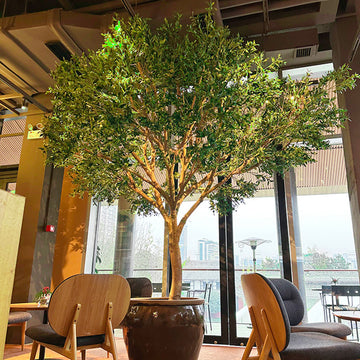


Successful staging is rarely about filling a house with decoration. It is about helping a prospective buyer walk through a space and immediately understand how it could feel to live there. A buyer touring an empty living room has to imagine furniture, lighting, gathering space, and warmth all at once — and most people simply aren't trained to do that kind of mental construction on their own. That is the real job of staging: translating an empty or transitional space into something legible.
This is where artificial plants for home staging have become a practical, widely used tool for real estate professionals, house flippers, and homeowners preparing a property for market. A well-placed faux tree or a cluster of realistic greenery can add warmth, vertical dimension, and visual softness to a room without introducing the maintenance demands of live plants — an important distinction for properties that may sit staged for weeks or months at a time, often unattended between showings.
There is also a business dimension worth noting up front, particularly for flippers, developers, and professional stagers: unlike paint colors or built-in fixtures, artificial greenery is portable. The same trees that anchor a living room in one listing can be relocated to the next property once that home sells. For anyone staging multiple houses a year, that reusability changes the economics of how staging inventory gets built and maintained.

Why Greenery Works in Home Staging
There is a design logic behind why greenery reads so well in staged interiors, and it has less to do with decoration and more to do with how the human eye processes a room. Most interiors are dominated by hard, rectilinear elements — walls, flooring, cabinetry, countertops, and boxy furniture. Plants, real or artificial, introduce organic shapes and irregular silhouettes that break up those straight lines. That contrast is part of why a single tree in the corner of a room can make the whole space feel more finished, even though nothing structural has changed.
Greenery also does useful work with scale and sightlines. A tall artificial tree draws the eye upward, which helps a buyer register ceiling height and the overall proportions of a room — something that's easy to underestimate in a bare space with no furniture for reference. In rooms with awkward, low-traffic corners, a floor plant or tree can make that dead space look intentional rather than overlooked, which matters because unused corners in listing photos tend to read as "wasted" or "unfinished."
This matters across nearly every room type in a staged home:
- Living rooms, where large windows and open floor plans can otherwise feel stark
- Entryways, where first impressions are formed within seconds of a buyer walking in
- Bedrooms, where a restrained touch of greenery can make a room feel calm rather than clinical
- Home offices, where buyers are increasingly looking for functional, livable workspace
- Dining areas, especially in open-plan homes where furniture groupings need visual anchoring
It's worth being clear about the goal here: greenery should never become the focal point of a listing photo or a showing. The goal is for the room itself to feel complete — for a buyer to look at the space and think "this works," rather than noticing the plant at all.
Why Artificial Plants Can Make More Sense Than Live Plants for Staging
Live plants can look beautiful in a staged home, but the operational realities of real estate staging often work against them. A staged property may be vacant for days or weeks between showings. It may sit with inconsistent heating or air conditioning, uneven natural light depending on window orientation and time of year, and no one on-site to water, rotate, or monitor plant health. Under those conditions, a live plant is a liability as much as an asset — a dropped leaf on a hardwood floor before a showing, a wilting fern in listing photos, or a plant that simply doesn't survive a six-week listing period are all avoidable problems.
This is one of the most practical arguments for fake plants for home staging: they hold their appearance regardless of watering schedules, sunlight exposure, or how long a home sits on the market. There's no leaf drop to clean up before a last-minute showing, no risk of pests, and no seasonal decline to manage. A tree placed in a staged living room in January will look the same in March.
These advantages compound for house flippers, developers, and professional stagers managing several properties at once. Live plants require a maintenance plan across every active listing — someone has to water them, check on them, and eventually deal with disposal or replacement. Artificial greenery removes that logistical layer entirely, which is a meaningful consideration when staging is one line item among many in a renovation or resale timeline.

Artificial Plants for Home Staging: Where They Have the Most Impact
Not every room benefits from greenery in the same way, and scale matters as much as placement. Below is a practical, room-by-room breakdown for anyone approaching real estate staging plants as part of a broader presentation strategy.
Living Room
The living room is usually where staged greenery does the most visible work. A tall artificial tree placed in an unused corner can balance an off-center sofa arrangement, soften the hard edge of a large window, and add height next to low-profile furniture like sectionals or media consoles. In open-plan homes, a well-placed tree can also help visually separate the living area from an adjacent dining or kitchen zone without adding a physical divider.
Entryway
The entryway sets the emotional tone for the rest of the showing. A single, well-proportioned plant near the door — not a cluster, not an oversized tree that blocks circulation — can make the first moment of a walkthrough feel warmer without creating clutter in what is often a tight, high-traffic space.
Bedroom
Bedrooms generally call for restraint. One quiet, well-placed plant near a window or dresser tends to outperform multiple botanical elements, which can start to feel busy in a room meant to read as calm and restful. The goal in a bedroom is softness, not statement-making.
Dining Room
In open-concept homes especially, a floor plant or tree positioned near — but not on top of — the dining set can help visually anchor that furniture grouping, giving buyers a clearer read on where the "dining zone" begins and ends within a larger open space.
Home Office
As more buyers prioritize a functional home office, staging that space convincingly matters. A modest plant on a desk or credenza, paired with a taller floor plant nearby, can make a staged office feel used and intentional rather than like an unused spare room with a desk pushed into it.
Empty or Awkward Corners
Awkward corners — the space behind a doorway, an odd nook created by a bay window, the dead zone next to a fireplace — are exactly where artificial trees earn their keep. The key is scale: a small tabletop plant in an oversized corner will look lost, while a floor-to-near-ceiling tree can fill that same space convincingly. As a general rule, match the height of the plant to the height of the negative space it needs to occupy, rather than defaulting to whatever size is easiest to store or transport.

Best Types of Artificial Trees and Plants for Real Estate Staging
Certain categories of artificial plants for real estate tend to perform consistently well across different property styles, which matters both for design impact and for stagers who need inventory that isn't overly trend-specific.
Artificial Olive Trees
Artificial olive trees have become a staging staple for good reason. Their slim, silvery-green foliage and gently textured trunks read as warm and organic without feeling overly stylized, which makes them a strong fit for Mediterranean-influenced interiors, organic modern homes, neutral palettes, and contemporary listings where the goal is broad buyer appeal rather than a strong design statement.
Artificial Fiddle Leaf Fig Trees
Faux fiddle leaf fig trees bring bold, large-leafed structure that works particularly well in modern homes, upscale apartments, and larger living spaces with high ceilings. Their strong silhouette makes them a good fit for architectural interiors where the staging needs to hold its own visually against clean lines and larger windows.
Artificial Ficus or Banyan Trees
Fuller-canopied artificial ficus trees add density and softness that suits larger rooms, transitional interiors, luxury properties, and entry spaces where a more substantial presence is appropriate. Their fuller foliage can do more visual "softening" work per square foot than slimmer varieties, which is useful in rooms with a lot of hard surface area.
Artificial Bamboo and Dracaena
For contemporary interiors, staged office spaces, bedrooms, and tighter spaces that still need vertical interest, bamboo and dracaena varieties offer a slimmer footprint without sacrificing height — a practical option when floor space is limited but a room still needs that upward visual pull.
Smaller Artificial Plants
Smaller plants have their own role to play: styling kitchen counters, shelving, bathroom vanities, consoles, and desks. These details add finishing touches without competing with larger statement trees elsewhere in the home.
Across all of these categories, the same principle applies: staging should generally favor restraint. A property should never look like a plant showroom — the goal is always to support the room, not to introduce a new focal point that competes with the house itself.
Recommended Products for Home Staging
Artificial Olive Tree Plastic Nordic Faux Potted 4 FT / 6 FT
Available in 4-foot and 6-foot options, this olive tree offers the type of adaptable scale that works well for residential property staging. The taller version can fill a living-room corner or balance a sofa, while the smaller option can suit bedrooms, offices and more compact entryways. Its relatively airy silhouette makes it particularly useful as a reusable hero tree that can transition between contemporary, organic-modern and neutral properties.

Signature Artificial Fiddle Leaf Fig Tree Indoor 6–8 FT
With 6-, 7- and 8-foot height options, this fiddle leaf fig is suited to spaces that need stronger vertical presence. It can work particularly well beside a sofa, console or tall wall in modern homes, upscale apartments and larger living areas. Compared with an airy olive tree, the broader foliage gives it more visual weight, making it useful when the plant needs to function as a significant compositional element.

Artificial Ficus Banyan Tree 5–7 FT
The 5- to 7-foot range makes this ficus-banyan option flexible enough for both standard residential rooms and more substantial interiors. Its fuller silhouette is particularly useful in larger living rooms, transitional homes and entryways where sparse greenery could feel underscaled. It can serve as either a hero element or a strong supporting piece depending on the surrounding furniture.

Artificial Dracaena Tree 6 FT & 8.5 FT
The taller, more upright form of a dracaena makes it valuable for narrow corners and areas where a broad canopy would interfere with circulation. In staging, it can work particularly well in home offices, bedrooms, apartments and contemporary spaces that need vertical interest without substantial visual bulk.

Real Touch Artificial Monstera Tree 3–7.5 FT
A broad height range allows this monstera to function as either supporting greenery or a larger floor-standing feature. Its more contemporary botanical character suits modern homes, condos, rentals and staged offices. Smaller versions can add controlled visual texture, while taller versions can fill larger corners without requiring additional furniture.

Tall Artificial Eucalyptus Tree Bonsai 8.1 FT Silver Dollar
At approximately 8 feet, this eucalyptus is better suited to larger rooms and properties where the architecture can accommodate a taller statement. It can work effectively in spacious living rooms, model homes and design-focused listings with higher ceilings. Because of its scale, it is best treated as a hero element rather than supporting greenery.

Why Artificial Greenery Makes Sense for House Flippers and Professional Stagers
For a house flipper or professional stager working through multiple properties a year, artificial trees are worth thinking about less as décor and more as reusable staging inventory. Unlike items purchased for one specific home, a well-chosen tree can move between flipped properties, vacant listings, model homes, furnished rentals, open houses, and even photography shoots — provided it was selected with versatility in mind from the start.
That versatility is the key design constraint for anyone building staging inventory at scale. A tree that only works in one very specific interior style has limited reuse value. Neutral, widely adaptable options — olive trees, fiddle leaf figs, ficus trees, and other restrained greenery — tend to integrate into a much broader range of properties, from a mid-century ranch to a new-construction contemporary, without looking out of place in either.
There are also practical operational considerations worth planning around:
- Transportation — plants that break down or pack reasonably flat are easier to move between job sites
- Storage — inventory needs a home between listings, so durability and ease of storage matter
- Durability — pieces that hold up to repeated handling and repositioning last longer as working inventory
- Planter selection — a few neutral planter options can update the look of the same tree across different properties
- Ease of repositioning — lighter, well-balanced pieces are simpler to adjust room to room without a second set of hands
- Height variety — a mix of tall, medium, and small pieces gives more flexibility across different room sizes
Building this kind of flexible inventory takes some upfront planning, but for anyone staging several properties a year, it can meaningfully simplify the logistics of getting each new listing photo-ready.

Staging for Listing Photography
Many buyers encounter a property for the first time through listing photographs, long before they ever schedule a showing. That makes photography one of the most important — and most overlooked — considerations in how a home is staged.
Greenery does specific, useful work in composition. A tall tree can frame an otherwise empty corner, giving a wide-angle shot a sense of depth instead of flat, undefined space. Placed carefully, plants can balance furniture groupings, add foreground or background layering, and provide vertical interest in rooms that would otherwise photograph as boxy or one-dimensional. In rooms with large blank walls, a plant positioned nearby can soften that expanse without the cost or commitment of artwork or wall treatments.
A few practical examples illustrate how this plays out in real listings:
- A tall olive tree beside a sofa can balance a large, otherwise empty corner in a living room photograph.
- A fiddle leaf fig positioned near a console table can help visually connect that furniture piece to a tall, blank wall behind it.
- Small plants on kitchen counters or bathroom vanities can add controlled, photogenic detail without introducing clutter into a tight frame.
The through-line across all of these examples is the same: greenery should support the architecture and furniture in a photograph, not dominate it. A plant that pulls the eye away from the room itself has done the opposite of its job.

Home Staging Mistakes to Avoid
Even well-intentioned staging can go wrong, and greenery is an easy place to overcorrect. A few recurring mistakes are worth flagging:
- Overcrowding a room with too many plants, which can make a space feel busy or gimmicky rather than warm
- Using plants that are too small for the space, leaving large corners or walls still feeling empty
- Choosing overly stylized or trend-specific varieties that may not suit the home's actual architecture or the taste of a broader buyer pool
- Placing greenery in high-traffic pathways, where it becomes an obstacle rather than a design element
- Letting plants block natural light, windows, or sightlines that buyers need to properly assess a room
- Treating plants as a substitute for addressing real issues — greenery should complement a well-prepared property, not distract from something that needs to be fixed
In almost every case, restraint produces a more sophisticated result than abundance. A staged home should feel curated, not decorated.
How to Build a Reusable Greenery Kit for Real Estate Staging
For professional stagers and flippers working across multiple properties, it's worth thinking in terms of a flexible, reusable inventory rather than one-off purchases for each listing. A practical starting kit might include:
- Two to three tall statement trees suited to living rooms and entryways
- Several medium floor plants for dining areas, offices, and secondary rooms
- A small selection of countertop or tabletop plants for kitchens, bathrooms, and shelving
- A few neutral planters or stands that can be swapped between properties to update the look
- A mix of planter heights to accommodate different ceiling heights and furniture arrangements
The right inventory mix depends heavily on the typical size and price point of the properties being staged — a kit built for compact starter homes will look different from one built for larger luxury listings. Whatever the scale, prioritizing pieces that work across multiple design aesthetics — rather than trend-specific pieces that only suit one style of home — will get more consistent use out of the same inventory over time. Wholesale artificial trees and plants are also worth exploring for stagers building out inventory at volume.
Why Faux Natural Is Relevant for Real Estate Staging
Faux Natural maintains a collection built specifically around artificial trees for real estate staging, developed with the practical needs of stagers, flippers, and agents in mind rather than purely residential decorating. Lifelike trees and staging-oriented greenery from the collection can be used to define living zones within open floor plans, soften transitional or hard-edged interior spaces, and generally support the kind of visual presentation that listing photography and in-person showings both depend on.
Beyond the real estate-specific collection, Faux Natural's broader range of realistic artificial plants and artificial trees offers additional variety for stagers who want to diversify their inventory across different property types, price points, and interior styles.
Frequently Asked Questions
What are the best artificial plants for home staging?
The most effective choices tend to be neutral, widely adaptable varieties — olive trees, fiddle leaf figs, and ficus trees — that read well across many interior styles rather than committing a room to one strong aesthetic. Size and proportion relative to the room usually matter more than the specific variety chosen.
Do plants help when staging a house for sale?
Plants are one tool within a broader staging strategy. They can add warmth, visual softness, and a sense of scale to a room, which supports how buyers perceive and connect with a space — but they work as part of an overall presentation, not as a stand-alone fix for a listing.
Are artificial plants better than real plants for real estate staging?
For staging specifically, artificial plants often make more practical sense because they don't require watering, consistent sunlight, or maintenance during a listing period that may last weeks or months, and a vacant property is often unattended between showings. Real plants can look beautiful but carry more risk of visible decline over an extended staging timeline.
Where should you place artificial trees when staging a living room?
Common effective placements include unused corners, beside sofas to balance an asymmetrical furniture arrangement, and near large windows to soften hard architectural lines. The goal is to fill negative space and add height without blocking sightlines or natural light.
What size artificial tree works best for home staging?
Size should be matched to the space it's filling — a small plant in a large, empty corner will look underwhelming, while an oversized tree in a tight space can feel cramped. As a general guideline, taller trees (roughly six feet and up) tend to work best for filling significant corner space or balancing large furniture pieces, while medium and smaller plants suit tabletops, consoles, and secondary spots.
Are artificial plants good for listing photography?
Yes — when placed thoughtfully, artificial plants can add vertical interest, depth, and layering to listing photos, particularly in wide-angle shots where empty corners or blank walls can otherwise look flat. They also hold their appearance consistently across every showing and photo session, unlike live plants that may decline over a long listing period.
Why do house flippers use reusable staging décor?
Reusable staging inventory, including artificial trees and plants, can move between multiple properties rather than being purchased fresh for each listing. For flippers and stagers managing several properties a year, this can simplify logistics and reduce the need to source new staging décor for every project.
How many plants should you use when staging a house?
Less is generally more. A handful of well-placed pieces — a statement tree or two in key rooms, plus smaller accents in secondary spaces — usually reads as more sophisticated than filling every room with greenery. Overcrowding a space with plants can undercut the clean, neutral look most staging aims for.
Conclusion
Good staging helps buyers do something that's genuinely difficult without help: interpret an unfamiliar space and imagine themselves living in it. Greenery plays a specific, supporting role in that process — adding warmth, scale, texture, and visual balance to rooms that might otherwise feel cold, empty, or hard to read in photos and in person.
Artificial trees and plants remove much of the maintenance burden that comes with live greenery during a listing period that can stretch on for weeks or months, which is part of why they've become a practical staple for professional stagers. For house flippers, developers, and stagers managing multiple properties, the ability to reuse the same well-chosen trees across different listings adds a business advantage on top of the design benefits.
For anyone building or refreshing a staging inventory, Faux Natural's collection of artificial trees for real estate staging is a practical place to start.


